Loose-leaf tea is one of the many ways to make a really fresh and delicious cup of tea. With tea bags, the tea leaves are confined to a small bag and are unable to fully expand during the brewing process. As a result, much of the tea’s flavor, aroma, and health benefits are not able to be extracted by the water. For those looking to get the full potential out of their tea, loose-leaf is definitely the way to go. But, for many, one of the first questions is: How much loose-leaf tea should one use to make a single cup of tea?
However, the amount of tea leaves to put in a tea infuser or directly into your teapot can vary depending on several factors. The size of the tea leaves, the type of tea, the typical method of brewing tea, and even your personal preference to how strong or weak you like your tea all play a role in how much tea to use for one perfect cup of tea.
Knowing the correct amount of tea to mix with water to achieve the right flavor is crucial. Without proper knowledge, one may end up in drinking a tea that is either too weak and watery or too strong and bitter. By knowing the correct tea-to-water ratio, one can easily make any changes necessary to achieve the perfect flavor for their tea.
Short Answer
We recommend using 1 teaspoon (about 2–3 grams) of loose leaf tea for an 8 oz (240 ml) cup of water. Adjust to your taste as necessary.
The exact amount will depend upon the type of tea you are attempting to make.
| Tea Type | Loose Leaf Tea Per 8 oz Cup |
|---|---|
| Black Tea | 1 teaspoon (2–3 g) |
| Green Tea | 1 teaspoon (2–3 g) |
| White Tea | 2 teaspoons (2–3 g due to larger leaves) |
| Oolong Tea | 1½ teaspoons (3–4 g) |
| Herbal Tea | 1½–2 teaspoons (3–5 g) |
| Pu-erh Tea | 1 teaspoon (3–4 g) |
It’s all about balance. These are a good starting point and from there you can play up or down to your personal preference.
Read more: Is Spearmint Tea available in India
Why the Amount Isn’t the Same for Every Tea?
Measuring Tea By The Teaspoon Often Isn’t Accurate.
To illustrate the point consider white tea made from large leaves, such as silver needle, and black tea which are compact and tight, rolled into small balls. The same teaspoon would contain very different weights of dry material because of their differing density. Also, there are herbal teas, like fruits and flowers, made from such diverse plants and material, that require a larger volume of material in a teaspoon than a single type of leaf such as black or green tea in order to achieve a strong flavor.
Of course, instead of measuring using teaspoons, tea enthusiasts also like to measure the tea using grams, especially for more expensive teas. There is a big difference between the density of black tea leaves that have been tightly rolled into small balls, and the large, fluffy leaves of white tea, for example. This is why many tea connoisseurs prefer to use a digital kitchen scale to measure out their tea.
Measuring Loose Leaf Tea by Teaspoon vs Grams
Both methods work well, but they serve different purposes.
For casual, at-home tea drinking, measuring with a teaspoon or even simply dumping the loose-leaf tea into the teapot is the fastest and easiest method to have a satisfactory tea-drinking experience. No need to buy a scale!
In many cases, measuring by weight using grams, is more accurate. For example, a high quality Pu-erh Tea may be too dense to measure using teaspoons, whereas a digital kitchen scale will give the exact amount every time. Using grams is particularly important when brewing very expensive teas.
Using teaspoons is a good place to start. Once you get more familiar with the variety of teas available and start to develop your own preferences for each, you can then measure the tea by weight using a digital kitchen scale. This will provide more accurate results as the density of teas can vary quite a lot.
Read more: does manzanilla tea have caffeine
Recommended Amount for Different Types of Tea
Each tea variety requires a special brewing conditions and has a recommended ratio for optimal flavor.
Black Tea
The Black Tea – It is one of the easier teas to make because of the dense leaves.
Use approximately:
- 1 teaspoon (2–3 grams) per cup
- Water temperature around 95–100°C
- Brewing time of 3–5 minutes
More tea in the pot can make the tea more stronger but also more bitter.
Green Tea
Because Green tea is much more fragile than Black tea we recommend brewing it in a much gentler way.
A standard cup usually needs:
- 1 teaspoon (2–3 grams)
- Water around 75–85°C
- Brewing time of 2–3 minutes
Too much tea or water that is too hot can bring out bitterness in the green tea.
White Tea
White tea leaves are larger and lighter than most other teas.
Two teaspoons may look like a lot, but they actually weigh about the same as the amount of green or black tea you’d typically use. The main difference is that the tea leaves are much larger than those of other teas.
A typical serving includes:
- 2 teaspoons (2–3 grams)
- Water around 75–85°C
- Brewing time of 4–5 minutes
Oolong Tea
The serving quantity for Oolong tea can vary greatly depending on the roll of the leaves. Generally, most types of Oolong tea can be brewed with 1 ½ teaspoons or 3 – 4 grams of tea leaves.
Most varieties brew well using:
- 1½ teaspoons (3–4 grams)
- Water around 90–95°C
- Brewing time of 3–5 minutes
Many oolong teas can be reinfused and yield many good brews.
Herbal Tea
Herbal teas are technically not teas at all, because they are not made from the Camellia sinensis plant.
Dried herbs and flowers are typically quite bulky, therefore more is required to fill up your teapot than you would with tea leaves, and a larger quantity is required to produce a fuller flavored cup of herbal tea.
- 1½–2 teaspoons (3–5 grams)
- Freshly boiled water
- Brewing time of 5–7 minutes
Using more of an herb or flower to make a tea creates a fuller flavor.
Read more: how long to steep chamomile tea
Does Cup Size Matter?
Absolutely.
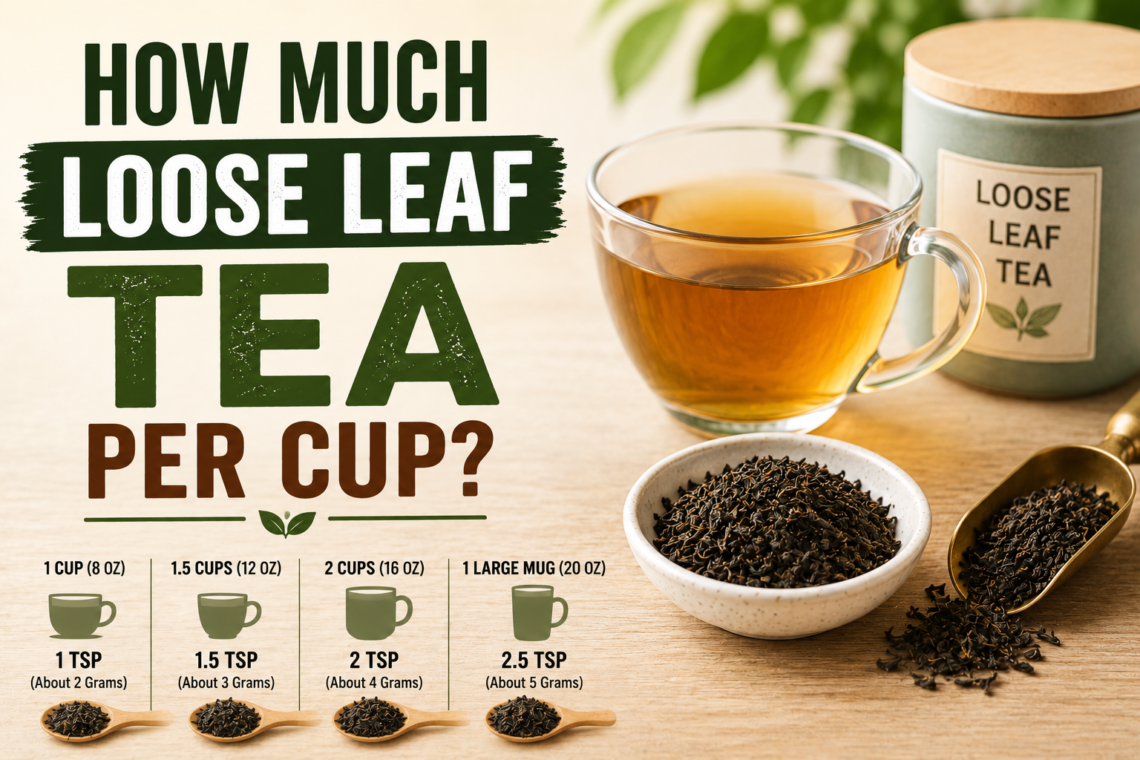
The amount of tea recommended in the preceding section was based on an 8-oz (240 ml) cup. Larger cups will require more tea. Here is a simple reference to help you ensure you have the correct amount of tea in your cup:
Here’s a simple reference:
| Cup Size | Loose Leaf Tea |
|---|---|
| 8 oz (240 ml) | 1 teaspoon |
| 12 oz (355 ml) | 1½ teaspoons |
| 16 oz (475 ml) | 2 teaspoons |
Adding more water without more tea leaves results in a weaker tea.
Should You Use More Tea for Stronger Flavor?
Using more tea leaves is a common misconception in trying to make stronger tea. While adding more tea does increase the flavor intensity, in most cases a slight increase in the steeping time will result in a more full bodied flavor without having to up the amount of tea used.
Steeping for a bit longer will produce a more full bodied tea and is the preferred way to increase flavor for most teas. However, for black and green teas there is a danger of extracting to many tannins and thus making the tea taste bitter.
If you prefer stronger tea, it’s generally better to make small adjustments rather than doubling the amount of leaves all at once.
Common Mistakes When Measuring Loose Leaf Tea
It really does make a difference if you measure your tea leaves incorrectly.
Some of the most common mistakes include:
- Using too many leaves for delicate teas.
- Brewing a large mug of tea and using the same amount of tea as you would for a small cup of tea.
- Ignoring the different densities of tea varieties.
- Using boiling water for green or white tea.
- Steeping the tea longer than recommended.
- Compressing fluffy leaves tightly into the measuring spoon.
Avoiding these mistakes will enable you to brew better tea and enjoy more perfect flavors in every cup.
Can You Reuse Loose Leaf Tea?
One of the advantages of loose leaf tea is that it can be reused in subsequent teas.
The higher quality teas will often yield different flavors with each subsequent steep. There are many teas that can be re-steeped, such as Oolong, white tea and pu-erh tea.
Generally:
- Black tea can often be steeped 2 times.
- Green tea usually brews well 2–3 times.
- Oolong tea may produce 4–8 infusions.
- White tea commonly provides 2–4 brews.
- Some varieties of Pu-erh Tea can be re-steeped up to 10 or more times, depending on your personal preference and the specific tea you are using.
Steeping time increases for each subsequent infusion.
Do Tea Leaves Expand During Brewing?
Yes.
Loose leaf teas, as they are submerged in water, expand greatly when in contact with hot water. This allows for all of the tea to be in contact with the water, allowing for the best extraction of flavor from the leaves. It is generally not recommended to use tea bags when brewing tea as the leaves are unable to expand greatly within the bag. This can result in a less flavorful cup of tea. Instead, consider using a tea infusers, teapots, or brewing baskets that allow for the leaves to greatly expand when in contact with water.
The same tea can be steeped in different size containers and still yield good results, but the leaves will need more room to open up in a smaller container than in a larger one. This is why a tea infuser, teapot, or brewing basket is often preferred over tea bags.
Crowding tea leaves in a small tea infuser will only serve to limit the extraction of the tea and result in a less flavorful cup of tea.
Tips for Brewing the Perfect Cup
Once you know the correct amount of tea to use to make the perfect cup, there are a number of simple things that you can be done to improve the flavor of your tea.
- Measure your tea consistently.
- Use fresh, filtered water whenever possible.
- Heat the water to the appropriate temperature.
- Avoid over-steeping delicate teas.
- Use an infuser that is large enough for your tea to expand in it.
- Adjust measurements gradually based on your taste preferences.
You’ll find the perfect ratio of tea to water within a few brews.
Final Thoughts
When it comes to black, green, oolong and pu-erh teas the generally recommended amount of tea for making the perfect cup is 1 teaspoon of loose-leaf tea (2-3 grams) per 8 oz cup. This amount can be adjusted to create your preferred strength of tea. White teas and herbal teas, however, are best made with slightly larger amounts of tea for the same volume of water. Also some teas such as rolled oolongs have a small amount of tea by volume but a large amount by weight. As with any tea, by adjusting the tea:water ratio, temperature and steep time you can be certain to be getting the best flavor from that particular tea and enjoy it exactly as you like it.
Frequently Asked Questions
How do I measure loose leaf tea using a teaspoon?
A normal kitchen teaspoon is the right size for everyday consumption of loose leaf tea. Weighing it (using a kitchen scale) is even more precise though.
Does using more tea increase the caffeine content?
More tea generally equals more caffeine. However, this is to be taken in conjunction with the length of time for which the tea is being steeped and the tea being consumed.
Should I level or heap the teaspoon?
A level teaspoon is the standard amount, but the tea manufacturer may suggest something different.
Is loose leaf tea stronger than tea bags?
There is no comparison between the flavor of tea bags and loose leaf tea. Typically, loose leaf tea will give a fresher taste, but the strength of the flavor can vary greatly depending on the amount of tea used to make the brew and the method in which it is being made.
How do I prepare loose leaf tea without an infuser?
Tea can also be placed directly in a pot or cup and then strained prior to drinking. This can be less neat than using an infuser or tea basket, but it is perfectly possible.