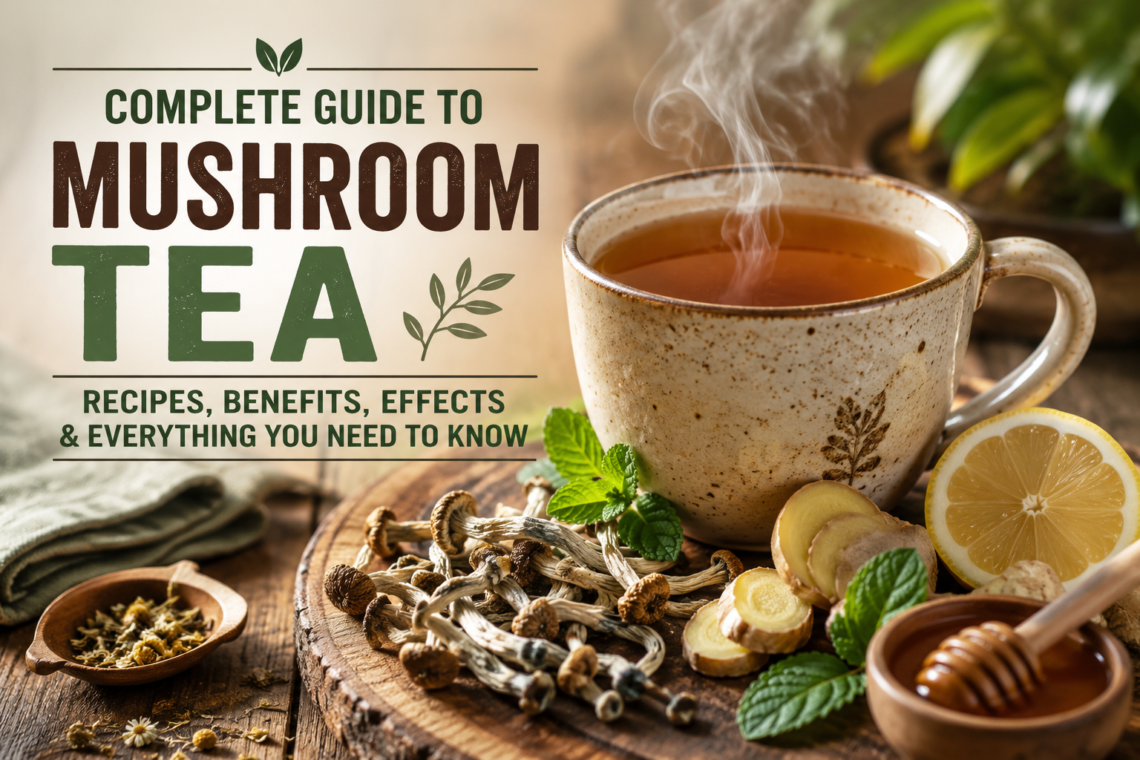
Psilocybin mushroom tea is a tea that is made by infusing hot water with psilocybin containing mushrooms. Sometimes additional ingredients like ginger, lemon, honey or even herbal tea are added to the tea to make it taste better.
By making a tea instead of eating dried mushrooms people find it an easier way to ingest the psilocybin and in some cases it is perceived to be a more enjoyable experience.
Some call it psilocybin mushroom tea, others refer to it as magic mushroom tea. Shroom tea and psilocybin tea are terms that are also commonly used, whereas online tutorials and educational web pages often use terms it simply as mushroom tea.
As we have explained previously, psilocybin mushrooms are often consumed in the form of a tea. When prepared correctly it is very easy to ingest and the flavors can be mixed up with a variety of recipes that typically use hot ingredients such as ginger and lemon, sweet honey, and also herbs such as peppermint tea, chamomile tea and green tea.
Unlike to other types of teas psilocybin mushroom tea contains a number of naturally occurring psychedelic compounds. These can produce a number of effects on the person who consumes them including changes in perception, feelings of euphoria, changes in thought patterns and the way in all of the senses.
The majority of species of mushroom that contain psilocybin are able to produce these effects due to the presence of the naturally occurring substance. This substance is a powerful psychoactive and it is converted by the body into the primary psychedelic compound psilocin.
There are many reasons why a person might choose to make and drink mushroom tea instead of consuming dried mushrooms. For one, many mushroom tea recipes are very tasty indeed.
A common method of preparation for making mushroom tea is to add the dried mushrooms to a pot of hot water. This allows the mushrooms to dissolve in the water, and then you can add in whatever other ingredients you like in order to create a unique tea flavor.
For example, some mushroom tea recipes include ginger and lemon. Also, many people like to add in a herbal tea bag to their mushroom tea in order to mix in the flavor of another type of tea.
In addition to adding in herbs, some mushroom tea recipes even include honey in order to give the tea an added layer of flavor.
Mushroom tea is widely discussed online but psilocybin is a controlled substance and its legality depends on the country and even the state within a country.
Much research is being done on the psilocybin in the fields of mental health and the brain studies and it is offered in some clinics around the world as part of a therapeutic treatment but this is only given under the closest supervision and in the few cases where it has been proven to be of benefit in treating serious problems.
In contrast, there is no such supervision when it is used recreationally and in many places it is even illegal to possess.
How To Make Magic Mushroom Tea And More Information About Shrooms And Mushroom Tea.
This information on how to make mushroom tea is intended to provide information to individuals interested in making and consuming mushroom tea and to answer any questions individuals have about psilocybin mushrooms, mushroom tea and other related substances and topics.
You will find out what psilocybin mushroom tea is, how it is used and consumed, why individuals make and use mushroom tea, how to make mushroom tea, how long does mushroom tea last, does heat affect psilocybin in mushrooms, how to store mushrooms for making tea, mushroom tea recipes and other information and answers to questions regarding the use of mushroom tea and the substances found in many species of psilocybin mushrooms.
What Is Psilocybin?
This page was written to try and explain what mushroom tea is and the process of making it. To be able to understand mushroom tea, it is best to first explain psilocybin.
Psilocybin is the naturally occurring psychedelic substance in over 180 species of fungi. Most species of Psilocybe contain this psychoactive substance and it is also found in smaller amounts in many other species of fungi.
Many people refer to mushrooms with psilocybin in them by a number of different names. This can vary depending on where someone is from and the online communities that they participate in.
Some of the more well known species of Psilocybe mushrooms include:
- Magic mushrooms
- Shrooms
- Psilocybin mushrooms
- Psychedelic mushrooms
- Hallucinogenic mushrooms
In simple terms the term ‘psilocybin mushrooms’ is often used to refer to any variety of fungi that contain the psychoactive compounds psilocybin and/or psilocyn. Other names for psilocybin mushrooms include:
There has been a great deal of research on psilocybin in the last decade as it may potentially be used to treat a number of different afflictions, including: Depression; Post-Traumatic Stress Disorder (PTSD); Illness-induced anxiety; Substance use disorders.
All of this research is still in its early stages and so far, psilocybin can only be prescribed by a doctor in a clinical or research setting, and only to participants who have been thoroughly screened.
There is a big difference between using psilocybin in research or clinical settings, and using it recreationally.
In clinical or research settings psilocybin is used under the strict supervision of licensed therapists, in a controlled setting, with very carefully screened participants, and with a strict protocol for dosing and supporting the participant before, during, and after the experience.
Read more: Honey Citrus Mint tea starbucks
Common Names for Psilocybin Mushrooms
Psilocybin mushrooms also go by many different names depending on the country, or even on the web page you are looking for information on.
This can make it difficult to find a mushroom tea recipe or information on the mushroom that you are interested in, especially when the mushroom is referred to by a different name on different web pages.
Some of the most common names include:
- Magic mushrooms
- Shrooms
- Psilocybin mushrooms
- Psychedelic mushrooms
- Hallucinogenic mushrooms
- Magic shrooms
- Mushies (slang)
- Boomers (slang)
There are also many species and strains of mushrooms referred to by name. Here are a few of the more well known species:
- Golden Teacher
- Penis Envy
- Liberty Caps
- Blue Meanies
- Psilocybe cubensis
- Psilocybe semilanceata
- Psilocybe azurescens
Additionally to the slang terms for mushroom species also the strain or species name is often used to refer to certain types of mushrooms.
Most of these species are well known in the mushroom community and can be found on many websites.
But it is essential to note that not every mushroom with a similar appearance contains psilocybin. And correct identification of wild mushrooms is difficult and requires a lot of knowledge.
Therefore, consuming wild mushrooms that have not been identified with certainty can be very dangerous, because there are many poisonous mushroom species that look very similar to edible or psychoactive mushroom species.
Read more: honey citrus mint tea
Why Make Mushroom Tea Instead of Eating Dried Mushrooms?
One of the most commonly searched for pieces of information regarding to mushrooms is why people would choose to make mushroom tea as opposed to simply eating mushrooms that have been dried.
Unfortunately for those who look for definitive answers there are as many reasons as there are people – i.e. different.
A frequent argument offered online in support of tea over ‘dried mushrooms eating’ is that their taste is unacceptable. If you eat dried mushrooms you can always add honey, ginger, peppermint, chamomile, or lemon, but that would change their nature too much in the case of many recipes.
To begin with, most people find it easier to ‘swallow’ mushroom tea than to chew up dried mushrooms, because for one thing the liquid goes down your throat immediately, and for another, while the tea remains in your mouth for a short time only, the flavor of dried mushrooms will linger there for a very long time.
Then again, hot liquids are very easily mixed with other things, so you can put any tea (herbal or medicinal) together with the mushrooms and make a hot drink of it all.
Another reason that mushroom tea is more acceptable to humans than eating dried mushrooms is that hot liquids are very easily sweetened with honey or ginger added to taste.
All in all, mushroom tea is easily made, is more acceptable to most people than dried mushrooms, and can be served hot and thus taken with other things, as well as being very easily sweetened.
Other reasons that people prefer to make mushroom tea instead of simply consuming dried mushrooms is that it is easier to consume mushrooms in tea form.
Also the warm liquid is an ideal base for other ingredients, so that for example honey, ginger, peppermint, chamomile or lemon can be added to create a tea that tastes familiar to the drinker.
Common reasons people prepare mushroom tea include:
- Easier to drink than eating dried mushrooms
- Ability to customize the flavor
- Can be combined with herbal teas
- Often prepared with honey or ginger
- Convenient to serve warm
- Multiple recipe variations are available
- Can be prepared using simple kitchen equipment
While there is considerable discussion about the reasons why people make mushroom tea, there is little scientific evidence that has been produced which compares the effects of mushroom tea with the other ways of ingesting dried mushrooms.
Read more: What kind of alcohol is in twisted tea
Types of Psilocybin Mushrooms
Magic mushrooms are known by many names. There are in fact many different species of mushrooms that contain the psychoactive compound psilocybin, which is found naturally in the fungi.
The majority of the species that contain psilocybin fall within the Psilocybe genus, but there are some species within other genera that also contain the compound. Each species can vary in appearance, natural habitat, and in the amount of psilocybin that they contain.
Psilocybin mushrooms can be found in various mushroom species all over the world, and they are divided into many different genera.
The most well-known genus is the Psilocybe genus. This is where you will find the most psilocybin-containing mushrooms. But, some species in other genera also have psilocybin.
The species of psilocybin mushrooms also vary greatly in shape and size and some of them are more potent than others.
Some of the best-known psilocybin mushroom species include:
- Psilocybe cubensis – This is probably the most well known of all psilocybin mushrooms. Because it’s so easily grown, it’s the most common mushroom that is distributed throughout the world over by people that cultivate it.
- Psilocybe semilanceata – Often referred to as Liberty Caps.
- Psilocybe azurescens: these mushrooms are known to contain higher amounts of psilocybin naturally than other species.
- Psilocybe cyanescens – Commonly called Wavy Caps because of their unusual shape.
- Psilocybe mexicana – A number of species have been used in early psilocybin research, Psilocybe mexicana is one of the most well known of these species.
- Psilocybe tampanensis This mushroom also produces the typical mushrooms, but in addition the organism also forms sclerotia are produced, that also contain high amounts of psilocybin and are used to make tea.
Within the Psilocybe cubensis species there are numerous ‘varieties’ of this mushroom that have been cultivated and studied by mushroom enthusiasts.
Some of the well-known varieties are:
- Golden Teacher
- Penis Envy
- B+
- Mazatapec
- Albino A+
- Ecuador
- Treasure Coast
These varieties of Psilocybe cubensis have been discussed in online forums and have been featured in various articles, but so far there is not much scientific comparison between the different varieties of this mushroom.
What Does Mushroom Tea Taste Like?
Mushroom tea, on its own, tastes earthy, woody and slightly bitter.
This is different from regular tea and is why many recipes mix it with other flavoring ingredients.
Most people add fresh lemon juice, ginger, honey, peppermint, chamomile, cinnamon or even other fruit teas and regular herbal teas to mask the earthy taste of the mushrooms.
Adding a squeeze of fresh lemon juice, some ginger, honey, peppermint tea, chamomile tea, cinnamon tea or even another fruit tea to the mushroom tea can mellow down the earthy flavor and create a very palatable health drink.
Many people describe mushroom tea as having:
- Earthy flavor
- Mild bitterness
- Woody notes
- Herbal aroma
- Slightly savory finish
Some of the flavors which you can add to your mushroom tea are:
- Sweet
- Citrusy
- Minty
- Floral
- Spicy
- Refreshing
Since recipes for mushroom tea can vary widely, there is no one flavor profile that describes mushroom tea in general.
Mushroom Tea vs Eating Mushrooms
Is Mushroom Tea Different from Eating Dried Mushrooms?
People like to drink mushroom tea for many different reasons.
One reason is that it is a warm and comfortable drink to have. Another reason is that it is very easy to add in a number of different flavorings to the tea in order to enhance the taste.
Many people like to add in things such as ginger, honey, lemon, and even peppermint in order to create a delicious tasting mushroom tea that they can enjoy.
Mushroom Tea vs Eating Mushrooms: An Overview of Key Differences
| Feature | Mushroom Tea | Eating Dried Mushrooms |
|---|---|---|
| Preparation | Requires brewing | Ready to consume |
| Flavor | Can be customized | Natural mushroom taste |
| Ingredients | Can include herbs, honey, or lemon | Mushrooms only |
| Texture | Liquid | Chewy |
| Variety | Multiple recipe options | No preparation required |
Each person’s experiences can vary greatly and to date, there is limited scientific research in order to draw comparisons between the different preparation methods for the tea.
Does Heat Destroy Psilocybin?
Does Heat Destroy Psilocybin in Mushroom Tea?
Yes, most mushroom tea recipes use hot water, but not boiling water.
Boiling water contains a lot of air, and vigorously boiling water will create a lot of foam.
For the taste reasons, most people prepare mushroom tea by first heating the water, then pouring it over the prepared mushrooms and letting them steep for several minutes.
After a few minutes, you can strain the liquid and serve it as tea, if desired.
People think that psilocybin is instantly destroyed by heat.
However, current science is not able to tell us everything there is to know about every possible method of preparation. Factors, In short, it seems to be broadly agreed that as long as the mushrooms are not boiled for too long then most of the psilocybin should remain intact.
For this reason, many recipes commonly recommend:
- Heating water until hot but not rapidly boiling.
- Pouring the water over the prepared mushrooms.
- Steeping for several minutes.
- Straining before serving if desired.
Heating the water, pouring it over the mushrooms and allowing them to steep for several minutes is how the vast majority of mushroom tea recipes are made.
This is often how mushroom tea is prepared and becomes part of someone’s diet.
Does Mushroom Tea Reduce Nausea?
Mushroom Tea: Less Nausea Than Dried Mushrooms?
Eating dried mushrooms can sometimes feel like it’s been stuck in your stomachs worse than they were before, whereas drinking mushroom tea is generally reported to have fewer issues with nausea.
This may be one of the reasons that many mushroom tea recipes include ingredients that are traditionally found in herbal teas in order to add flavor to the drink.
Some of the most commonly used flavorings for mushroom tea include ginger, peppermint and chamomile. Honey, lemon juice and other sweet and sour flavorings are also very popular.
Some commonly added ingredients include:
- Fresh ginger
- Peppermint
- Chamomile
- Honey
- Lemon
As far as I can find, there is not a lot of scientific research comparing nausea between mushroom tea and whole mushrooms (dried or fresh), so this is a bit of a guessing game.
Many of my clients do say that they feel mushroom tea is easier on their stomachs than dried mushrooms but everyone is different.
Does Mushroom Tea Hit Faster?
Many people ask whether drinking mushroom tea has more immediate effects than consuming dried mushrooms.
This is not to say that tea will have a different onset of effects, but rather that there are so many variables that could affect onset that it is not possible to say whether or not a liquid form of a mushroom will have a different onset of effects than whole mushrooms.
Amount of ingested material, digestive contents, metabolism, method of preparation, and the individual’s general state of health are just a few of the variables that could potentially affect the onset of effects from a ingested mushroom.
While there are many anecdotal reports of the effects of mushroom tea happening sooner than effects from eating dried mushrooms, there are no controlled scientific studies that compare the effects of mushroom tea to the effects of whole mushrooms prepared in other ways, and that take into account the many factors that can influence the onset of effects.
Several factors may influence how quickly effects begin:
- Individual metabolism
- Whether food has recently been eaten
- Preparation method
- Amount consumed
- Beverage temperature
- Individual physiology
All of the factors above influence the onset of effects for any given individual.
Thus, there is no onset time for mushroom tea that will be true for every person.
Why Do Many Recipes Include Lemon?
Many recipes for mushroom tea include lemon for flavor and preparation purposes.
Lemon is added to many mushroom tea recipes for flavor and for preparation, as its bright citrus flavor helps balance out the earthy flavor of the mushrooms and makes for a refreshingly tasty tea.
The lemon can be simply added to the mushrooms as fresh squeezed juice, or prepared as a variation of the Mushroom Tea called Lemon Tek.
Lemon Tek is made by first mixing the tea mushrooms with the lemon juice, and then adding hot water to the mixture.
In many standard mushroom tea recipes, lemon is included because…
- Adds fresh citrus flavor
- Reduces bitterness
- Pairs well with honey
- Blends well with ginger
- Complements herbal teas
Most recipes that include lemon can also be prepared without it.
Common Ingredients Used in Mushroom Tea
One of the advantages of mushroom tea recipes is their flexibility.
Some of the most commonly used ingredients include:
- Hot water
- Fresh lemon juice
- Honey
- Fresh ginger
- Peppermint
- Chamomile
- Green tea
- Black tea
- Herbal tea
- Cinnamon
- Orange slices
- Turmeric
- Lemon balm
- Agave syrup
Recipes often use only a few of these ingredients to make a tea, and many recipes use several ingredients to create a more complex flavor profile all made with the same method of preparation.
How to Make Mushroom Tea
To make Mushroom Tea there are many different methods, but generally speaking all recipes follow a similar procedure of extracting the nutrients from the mushroom into the tea liquid.
Also, the tea is much easier to consume in this form than dried mushroom form.
Some recipes for mushroom tea include additional flavoring ingredients like ginger, honey, lemon, peppermint, or even chamomile tea.
The simplest recipes, however, contain only the mushrooms and hot water.
Some people like to add a squeeze of fresh lemon juice and a spoonful of honey to their mushroom tea, while others like to make a peppermint or chamomile tea and add dried or fresh mushrooms to it in order to get the medicinal benefits of the fungi and a milder flavor.
Most mushroom tea recipes are made with basic kitchen equipment and can be completed within 30 minutes.
Ingredients
The ingredients for mushroom tea can vary greatly from person to person and from recipe to recipe.
However the most basic recipe for mushroom tea would include the following:
- Dried psilocybin mushrooms
- Hot water
- Fresh lemon juice (optional)
- Honey (optional)
- Fresh ginger (optional)
- Peppermint tea (optional)
- Chamomile tea (optional)
- Green tea (optional)
Equipment
Preparing mushroom tea to drink is easy, using simple items found in your kitchen.
Common equipment includes:
- Kettle or saucepan
- Mug or teapot
- Knife or grinder
- Fine mesh strainer
- Spoon
- Measuring cup
Step 1: Prepare the Mushrooms
Typically the first step in any mushroom tea recipe is to chop, crush or grind the dried mushrooms.
Breaking them up into smaller pieces increases their surface area and thus allows them to be more easily ‘steeped’ in the hot water.
Cutting or grinding the mushroom to a fine particle can also be done using a knife or a small herb grinder or even a food processor.
Step 2: Heat the Water
Heat fresh water until it is hot.
As an alternative to adding the mushrooms to boiling water, it is generally suggested that the water is heated up as far as is necessary, then allowed to cool slightly before being added to the mushrooms for steeping.
Step 3: Add Optional Ingredients
Some recipes for mushroom tea include additional ingredients.
These are usually added before or after the mushroom infusion.
Popular additions include:
- Fresh ginger
- Honey
- Lemon juice
- Peppermint
- Chamomile
- Cinnamon
- Green tea
- Black tea
Some of the ingredients listed above are added to mushroom tea in order to change the flavor, so they can be used in addition to the basic preparation steps outlined above.
Step 4: Steep the Tea
First, pour hot water over the prepared mushrooms and allow the mixture to steep for a period of time.
You should let the tea steep for as long as your recipe calls for. This can be anywhere from a few minutes to longer.
Remember to not reboil the mixture in the following steps unless the recipe specifically states to do so.
Step 5: Strain and Serve
After the tea has been allowed to steep for the appropriate length of time, the liquid is strained through a fine mesh in order to remove the remaining pieces of mushrooms from the tea.
Serve the mushroom tea as is or add honey, lemon or other herbal teas to taste.
Mushroom Tea Recipe
Unfortunately there is no recipe that is made and used by everyone.
Even the recipes on this page contain different ingredients and of course also different ways to prepare.
Most recipes use hot water and some optional flavorings (such as honey, lemon juice or fresh ginger) to make the tea.
Basic Mushroom Tea Recipe
Ingredients
- Dried psilocybin mushrooms
- Hot water
- Honey (optional)
- Lemon juice (optional)
- Fresh ginger (optional)
Instructions
- Chop or grind the mushrooms into small pieces.
- Heat the water until hot.
- Place the mushrooms into a mug or teapot.
- Pour the hot water over the mushrooms.
- Add optional ingredients if desired.
- Allow the mixture to steep.
- Strain the liquid.
- Serve while warm.
Even the most basic Mushroom Tea can be modified using other herbal teas or additional flavorings.
Lemon Tek Mushroom Tea
One of the most commonly discussed teas online in the mushroom community is Lemon Tek Mushroom Tea.
Combining fresh lemon juice with hot water and your favorite mushrooms makes a really tasty and enjoyable Mushroom Tea.
This method of preparation is widely known as ‘Lemon Tek Mushroom Tea’.
A Lemon Tek tea recipe often includes:
- Dried mushrooms
- Fresh lemon juice
- Hot water
- Honey
- Ginger
You will find Lemon Tek recipes all over the web, but they are highly varied and there is no single method or recipe that most people agree with.
Best Water Temperature for Mushroom Tea
One of the more popular discussions concerning mushroom tea is the water temperature to use when making it.
On our pages many recipes are described in which hot water is used to prepare mushroom tea instead of boiling water.
Fresh water is heated up, then removed from the heat and poured over the mushroom material. In this way, the tea is prepared optimally and is not exposed for too long to high temperatures.
A typical preparation involves:
- Heating fresh water
- Removing it from direct heat
- Pouring it over the prepared mushrooms
- Allowing the mixture to steep
You can find slight variations on how to make Mushroom Tea using different water temperatures but generally they follow this method of preparation.
How Long to Steep Mushroom Tea
Searches such as “how long to steep mushroom tea” or “how long to steep magic mushroom tea” are probably the most common searches of people interested in mushroom tea.
The amount of time to allow the tea to steep varies depending on the recipe.
Some recipes are to steep for a shorter amount of time and allow the mushrooms to be in the hot water for a longer period of time before straining out.
The exact time depends on factors such as:
- Recipe being followed
- Water temperature
- Mushroom preparation
- Personal preference
By following a particular recipe the best results can be achieved.
Should You Strain the Mushrooms?
Whether or not to strain the mushrooms from the tea is also up to personal preference.
Some recipes include straining the mushrooms from the liquid while others leave them in the tea for the entire steeping time.
Most people prefer to use a fine mesh strainer to make the finished tea smooth to drink.
Some people choose to drink their mushroom tea with the mushroom pieces still in the liquid and others prefer to remove them with a fine mesh strainer to make a smoother drinking liquid.
There are several reasons for each.
- The drink has a smoother texture.
- Fewer solid pieces remain.
- The beverage resembles traditional tea.
Other recipes however state to leave the mushrooms in the cup and do not have to be strained.
Common Mistakes When Making Mushroom Tea
Mushroom tea is simple to make and even has many simple recipes.
Yet, there are some mistakes that appear again and again in recipes as well as online forums.
These mistakes can be avoided to create a good mushroom tea.
Common mistakes include:
- Using water that is excessively hot.
- Forgetting to strain the tea when making a smooth drink.
- Adding too much sweetener.
- Using poor-quality ingredients.
- Skipping flavoring ingredients when trying to reduce bitterness.
- Using stale herbs or tea bags.
- Overcomplicating the recipe with unnecessary ingredients.
A number of recipes will work with simple ingredients and a simple process for making mushroom tea.
How Long Does Mushroom Tea Take to Kick In?
How Long For Effects to Begin
One of the most common questions we receive from prospective customers before purchasing mushroom tea is the time in which mushroom tea begins to affect the user.
Unfortunately the time it takes for mushroom tea to affect an individual varies greatly from person to person.
The onset of the effects of mushroom tea can vary greatly from person to person, and even from one time to another for the same individual.
Factors that determine the onset time include: the individual’s metabolism, whether the person has eaten any food recently, the individual’s body composition, the method of preparation, the type of mushroom being consumed, the amount being consumed, and the individual’s overall health.
Several factors can influence onset, including:
- Individual metabolism
- Whether food has recently been eaten
- Body composition
- Preparation method
- Mushroom variety
- Amount consumed
- Overall health
Given that there are numerous variables that affect the effects of mushroom tea, it is not possible to give a certain time of onset for the effects of the mushroom tea.
How Long Does Mushroom Tea Last?
Search Terms – How Long Does Mushroom Tea Last?
Again, this is to vary from person to person.
In terms of the effects lasting for how long, the answer is to vary as well.
Rather than looking for a time span for the effects of the tea to last for each of the different types of teas, the duration of the effects of the tea will vary from person to person.
Several factors that may influence duration include:
- Mushroom species
- Individual metabolism
- Amount consumed
- Preparation method
- Whether food was recently eaten
- Individual physiology
Every person is different and the effects of mushroom tea can last for a different amount of time for every person.
Mushroom Tea Effects
Psilocybin mushroom tea contains naturally occurring psychedelic compounds that may produce changes in perception, thinking, mood, and sensory awareness.
Because Psilocybin mushroom tea contains psychedelic compounds it can alter a person’s perception of reality in regards to their thinking, mood and sensory awareness.
While there is more and more scientific research done about the effects of Psilocybin on the brain, especially how it works with the serotonin receptors, there are a lot of variables that can alter a person’s experience.
People commonly describe experiences involving changes in:
- Visual perception
- Sense of time
- Emotional state
- Thought patterns
- Sensory awareness
- Creativity
- Introspection
The intensity and type of effects can vary a lot between people and therefore cannot be promised to affect everyone in the same way.
Possible Side Effects of Mushroom Tea
As with other preparations that contain psilocybin, there are potential negative effects of mushroom tea on some individuals.
Possible side effects may include:
- Nausea
- Vomiting
- Dizziness
- Anxiety
- Confusion
- Increased heart rate
- Sweating
- Dry mouth
- Dilated pupils
- Difficulty concentrating
Everyone may experience different side effects and they can be of different degrees of severity.
If you experience severe or even lasting symptoms, you should immediately consult a doctor.
Potential Risks
While research on therapeutic uses of psilocybin mushroom tea is ongoing, using it without medical supervision can have negative effects.
Potential risks discussed in scientific literature include:
- Impaired judgment
- Increased risk of accidents
- Anxiety or panic
- Distressing psychological experiences
- Interactions with certain medical conditions
- Interactions with some medications
There are many people who suffer from mental health disorders.
Any substance which can affect the brain should be discussed with a qualified healthcare provider if you have a previous or current mental health disorder.
Can Mushroom Tea Cause a Bad Trip?
A ‘bad trip’ refers to the worst of psychedelic experiences and are reported to be intensely distressing.
Everyone has a different experience and there are many variables that affect a person’s experience with psychedelic substances.
The setting, the person’s emotional state, and their preconceptions can all greatly affect their experience.
Additionally, each person has a different sensitivity and it can be very hard to anticipate a person’s specific reaction to the substance.
Some reported experiences include:
- Intense fear
- Anxiety
- Confusion
- Paranoia
- Emotional distress
It is unknown how any individual will react on any given trip.
Can You Overdose on Mushroom Tea?
Can you overdose on Mushroom Tea?
While fatal toxicity from psilocybin itself appears to be rare according to current medical literature, there are many risks associated with the consumption of mushrooms in general.
Chief among these is the risk of accidental poisoning by misidentifying a wild mushroom for a edible psilocybin containing mushroom.
There are many poisonous mushrooms that look very similar to psilocybin containing mushrooms.
If one were to experience severe symptoms after ingesting a mushroom, one should immediately seek medical attention at the emergency room.
If someone has severe symptoms after ingesting an unknown mushroom they should seek immediate medical attention.
Drug Interactions
Psilocybin can interact with some medications and some medical conditions.
Examples commonly discussed in medical literature include:
- Antidepressants
- Antipsychotic medications
- Mood stabilizers
- Anxiety medications
- Blood pressure medications
It is extremely important for anyone who is on medication and is considering using substances that may interact with the said medication to consult with a qualified medical professional first.
Is Mushroom Tea Legal?
As Psilocybin mushroom tea is consumed in many parts of the world it is considered to be illegal or controlled in most countries around the world.
Psilocybin is a controlled substance in most countries, however there are various circumstances in which psilocybin may be used for medical or research purposes, in some places even be decriminalized or be used as part of a therapeutic program under close medical supervision.
New laws are frequently being created in regards to psilocybin containing substances and these laws change frequently.
If you’re seeking legal information in relation to mushroom tea and its legality you should seek the most up-to-date information for your country, state or region.
| Region | Legal Status |
|---|---|
| United States | Varies by federal, state, and local laws |
| Canada | Limited medical and research access in certain circumstances |
| United Kingdom | Controlled substance |
| Australia | Regulations vary depending on medical use and jurisdiction |
| Europe | Varies by country |
How to Store Mushroom Tea
How to Store Mushroom Tea | Tips to Keep Mushroom Tea Fresh.
Once mushroom tea has been made and not been consumed straight away it’s best to allow it to cool and then put it in a clean airtight container in the fridge.
General storage recommendations include:
- Store in a clean airtight container.
- Refrigerate after cooling.
- Avoid repeated heating and cooling.
- Keep away from direct sunlight.
- Discard if unusual odor, appearance, or spoilage develops.
Storage of mushroom tea depends on the ingredients used ingredients and the method of preparation of the tea.
Final Thoughts
Psilocybin mushroom tea is one of the most commonly used methods for consuming psilocybin containing mushrooms.
The method of making mushroom tea is simple, many recipes can be altered to better suit one’s taste, and it can be combined with other teas as well as honey, lemon, ginger and more.
Because of the simplicity of the method and the varied recipes online, it has become a staple in online forums as well as in educational resources regarding the substance.
Additionally, the study of psilocybin is currently undergoing much scientific research and each individual will experience effects, risks and side effects differently, so it is always best to learn more about it through evidence-based and reliable information sources.
In conclusion, it is critical to gain knowledge from reliable, evidence-based resources regarding the psilocybin containing mushroom and its’ effects, risks, legal status, and ongoing research.
Rather than reading about mushroom tea in online recipes, preparation methods, and discussions, the person with interest will gain a more balanced perspective by studying from reliable resources.
Frequently Asked Questions
What is another name for psilocybin mushroom tea?
Psilocybin mushroom tea is also known as magic mushroom tea, shroom tea, psychedelic mushroom tea or psilocybin tea.
Can mushroom tea be made with fresh mushrooms?
Some recipes will use fresh mushrooms to make mushroom tea and others will use dried mushrooms to make mushroom tea.
Can mushroom tea be made without herbal tea?
There are many recipes that only include mushrooms and hot water, but that use herbal teas in order to add further flavor to the mushroom tea.
Why do many recipes include ginger?
Ginger is added to the mushroom tea in many recipes because of its similarity in taste to the earthy mushroom, and ginger is a common addition to herbal teas.
Can honey be added to mushroom tea?
Yes. Honey is one of the most used sweetener for mushroom tea.
Can mushroom tea be served cold?
Yes. For example in the tea recipe below prepared mushroom tea can be chilled in the refrigerator and then served over ice.
Can mushroom tea be reheated?
When reheating mushroom tea it is best to do it gently in order to avoid bringing the tea to a boil.
Can mushroom tea be frozen?
Yes, it is possible to freeze mushroom tea. There are many different methods for storage of frozen mushroom tea.
Does mushroom tea taste bitter?
To reduce bitterness earthy flavored mushroom tea is often mixed with honey, lemon or ginger.
Can you mix mushroom tea with green tea?
Yes. Green tea is often mixed with mushrooms to make this tea.
Can chamomile be added?
Chamomile: Yes. This is another tea commonly used in mushroom tea recipes because it has a very mild flavor of a floral taste.
Is peppermint commonly used?
Yes, peppermint is another ingredient that is commonly added to mushroom tea to enhance the flavor.
Can cinnamon be added?
Yes. In some recipes, you add cinnamon to give the mushroom tea some more warmth and aroma.
Can mushroom tea be stored overnight?
Most recipes recommend to store the tea overnight in the fridge.
What kitchen equipment is needed?
Many mushroom tea recipes require nothing more than ordinary kitchen equipment such as a kettle, a saucepan, a mug, a spoon and a fine-mesh strainer.
Should mushroom tea be strained?
Whether to strain mushroom tea out or to leave the mushrooms in the tea is up to personal preference.
Some people prefer to have a smoother tasting tea and therefore strain the mushrooms out while others like to have the actual mushroom in their tea.
Can lemon be omitted?
Yes. Lemon is optional in the recipes listed above but is the most commonly used ingredient after the mushroom.
Can different herbal teas be used?
Yes. In addition to peppermint, many people make use of tea bases such as chamomile, green tea, and other herbal teas.
Does every recipe use honey?
No. Some recipes use honey and others use a different sweetener or no sweetener at all.
Why is mushroom tea so popular?
Mushroom tea is a very popular beverage because it is easy to make with a variety of ingredients including honey, ginger, lemon and many different herbal teas.
In fact, mushroom tea is a very healthy alternative to eating dried mushrooms whole because it can be consumed as a warm tea.