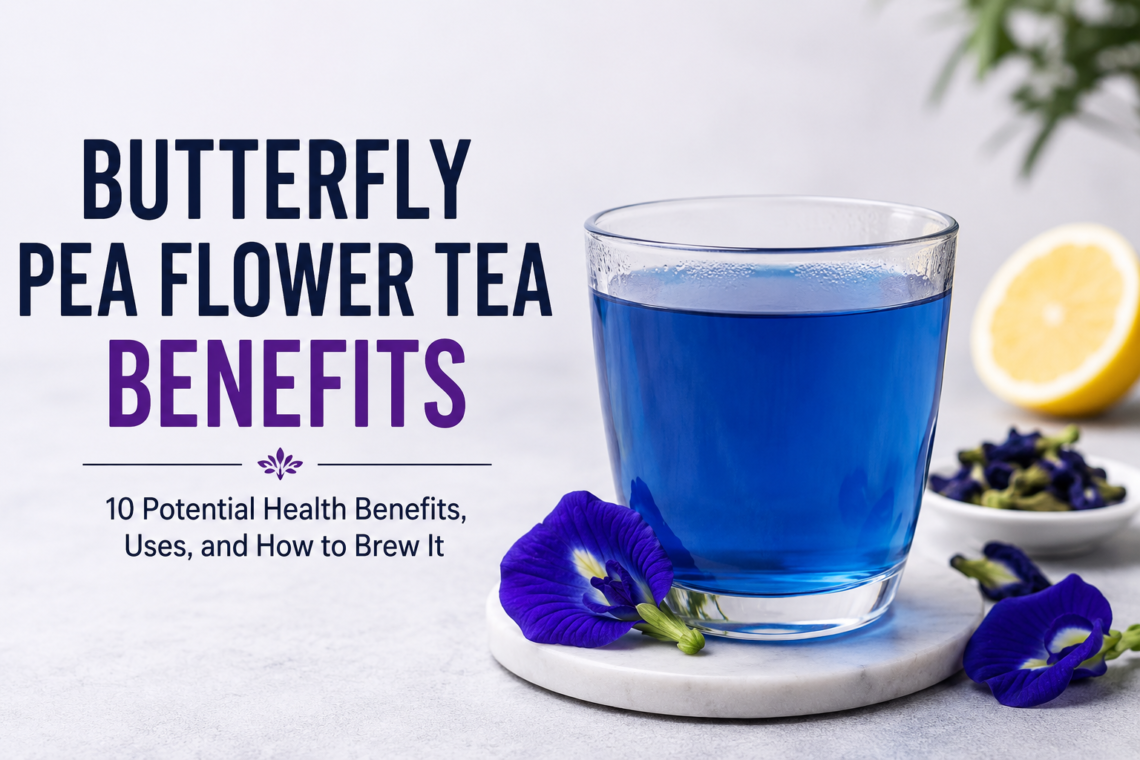
The most known characteristic of the Butterfly Pea Flower Tea is its intense blue color and effect that the tea has on the color when lemon is added to it. But apart from its many colors, this herb is very healthy and has many benefits for our body and health. Its active components are plant-based and are known as ternatins, which are part of the anthocyanin family.
Until more studies are conducted with humans, it is best to consider the information provided for the butterfly pea flower in terms of potential benefits to health. Research is ongoing and several studies, both animal and human, are providing information on potential health benefits of this plant.
In other words; what are the potential health benefits of the Butterfly Pea Flower Tea and how do you use it for its intended purposes?
This guide takes a detailed look at all of the butterfly pea flower tea benefits and offers suggestions on how to make use of this green drink. It also outlines the evidence that currently supports the use of this herbal tea and outlines its caffeine content, possible side effects and more. Finally, we take a detailed look at the color-changing effect that can occur when lemon is added to the drink.
What Is Butterfly Pea Flower Tea?
So what is butterfly pea flower tea made from? It is made from the dried flower of the plant Clitoria ternatea, native to parts of Southeast Asia and grown in tropical and subtropical regions worldwide. Interestingly the Butterfly Pea flower is not made from the tea plant (Camellia sinensis) and so is actually an herbal tea, or tisane, rather than a true tea.
Note that, unlike black, green, white or oolong tea, butterfly pea flower tea is not made with Camellia sinensis and therefore it is an herbal infusion or tisane.
The flowers of the Clitoria ternatea plant contain naturally occurring pigments. The anthocyanins found in the flowers of the butterfly pea flower are a group of compounds known as ternatins.
Butterfly Pea Flower Tea is made from dried flowers of the tropical butterfly pea flower plant. Steeping these dried flowers in water creates a deep blue liquid. Adding an acidic substance such as lemon or lime creates a purple, violet, or even pinkish color.
First of all, it’s worth noting that herbal teas don’t have as strong of flavors as their black, green, white or oolong tea counterparts. As for the butterfly pea flower tea taste, it can best be described as earthy, mild and somewhat floral when consumed without any additional ingredients.
10 Potential Butterfly Pea Flower Tea Benefits
There are several benefits of Butterfly Pea Flower Tea, which can be associated with the anthocyanins that the plant contains. These benefits can be grouped based on the evidence of laboratory studies, animal studies and human studies.
1. Provides Antioxidant Compounds
The fact that butterfly pea flower is high in anthocyanins is one of the reasons that it has been studied.
Anthocyanins are naturally occurring pigments found in many fruits, such as blue, purple and red ones. These also possess antioxidant activities. They can interact with free radicals and oxidative processes, often used in laboratory tests to show potential antioxidant effects of certain compounds.
Ternatins are a group of the particular anthocyanins found in butterfly pea flowers. There is considerable scientific interest in using the ternatins found in butterfly pea flowers as potential sources of antioxidant and anti-inflammatory compounds.
We must also be careful not to imply that drinking butterfly pea tea will help detoxify the body or in any way prevent disease. There is limited evidence in human studies and the effects of compounds in isolated studies and of concentrated extracts cannot be extrapolated to the ingestion of a cup of tea.
Incorporating butterfly pea flower tea into your diet can provide antioxidant compounds in addition to typical fruit and vegetables.
2. May Support Healthy Blood Sugar Responses
This plant has been subject to research with respect to blood sugar as well.
The research suggests that compounds found within the flowers of Clitoria ternatea may also affect the digestion of carbohydrates and the resultant impact upon glucose levels within the blood. A number of human studies have found that the consumption of Clitoria ternatea extracts can decrease glucose levels and the corresponding insulin response following consumption of sugary drinks (sugars).
Even if the study results in lower levels of blood glucose and insulin in the participants, that does not necessarily mean butterfly pea flower tea is suitable for people with diabetes.
Some of the studies carried out so far on Butterfly Pea have been small in terms of the number of people taking part in them, and extracts of the plant have been used rather than tea prepared in the normal way.
It is not advisable for individuals with blood sugar concerns to rely on butterfly pea tea for treatment as there are not sufficient human studies to prove its effectiveness.
3. May Have Anti-Inflammatory Potential
Oxidative stress and inflammation are two interconnected processes that have been the subject of much interest regarding the antioxidant compounds found in butterfly pea flowers.
Most of the biological studies on butterfly pea flower extracts have reported the finding of some kind of activity including anti-inflammatory activity. The use of this flower in herbal preparations for many years could be related to its reported activity.
From what we can tell from the studies conducted so far, it is not expected that drinking a normal cup of butterfly pea tea will have any appreciable anti-inflammatory effect.
For now, though, it remains a promising area for researchers.
4. May Support Brain and Cognitive Health
Throughout history, the Butterfly Pea flower has been used for many different health purposes in many cultures including traditional SE Asian and Ayurvedic practices, as well as other global regions and practices.
Some of the studies involving traditional uses of Clitoria ternatea have investigated the memory, learning and nervous system effects of C. ternatea extracts. The results are mostly from animal or laboratory studies and need to be confirmed by more human studies.
While some of the evidence was obtained from animal or laboratory studies, these would not represent human clinical trials and, therefore, cannot be used as evidence to support health claims for this extract.
Again, there is no science that supports the idea of butterfly pea flower tea being a treatment for any form of memory loss or even as a memory enhancer. This makes for a wonderful and healthy beverage but not a product to be ‘sold’ under any false pretenses.
The tea can, however, be a useful caffeine-free beverage that consumers can consume as part of a normal healthy diet without regard to any excessive claims concerning its effect on human memory.
5. May Support Skin Health
Antioxidant-rich plant extracts have been studied in order to prevent oxidative stress or other damage to cells. Thus, research on the antioxidant compounds found in butterfly pea flowers could potentially support skin health.
Butterfly pea flower extracts have been studied for their effects on outcomes of skin health including hydration. Some of the studies with topical butterfly pea flower extracts have shown positive results for skin health.
The effects of applying concentrated extract of Clitoria to skin are different from that of drinking extract of Clitoria as tea and therefore require separate human studies to establish health effects.
This does not mean that the application of extracts of butterfly pea flowers to skin has not been shown to have certain effects. Evidence that a topical extract has affected the skin does not necessarily translate to effects being found when the same extract is drunk in the form of a tea.
In order to come to conclusions about the effects of drinking butterfly pea flower tea on the skin, much more research has to be conducted with human participants. Right now, studies have only been done with test tubes with butterfly pea flower extracts.
6. May Be Useful as a Caffeine-Free Alternative
One of the best aspects of Butterfly Pea Flower tea is that it is made from 100% pure Butterfly Pea Flowers, making it a great alternative to traditional tea.
Since butterfly pea flower tea is not made from the tea plant, Camellia sinensis, it is naturally caffeine-free.
This beverage is distinct from black, green, oolong teas and many other tea blends in that Butterfly Pea Flowers are used to make Pure Butterfly Pea Flower Tea which is 100% caffeine free.
For sensitive stomachs and individuals who are trying to avoid caffeine consumption in the afternoon and evening hours, butterfly pea flower tea is a great choice as a warm and healthy beverage.
In blends of herbal teas to which butterfly pea flowers have been added, however, there will be caffeine from the green, black, oolong, or matcha teas included in the mix as well as the herbal. It is best to read the list of ingredients to know for sure what you are getting.
7. May Support a Healthier Beverage Routine
A plain serving of Butterfly Pea Flower Tea is made with very few calories when served unsweetened and without add-ins such as sugar, honey, milk or syrup.
This is how a healthy alternative to sugary soft drinks looks like. It does not contain any calories when it is consumed as an unsweetened herbal tea.
The real benefit of drinking unsweetened herbal teas like the violet drink made from the flowers of the Butterfly Pea Plant is what you are replacing in your diet. You could be drinking sugary soft drinks, but these can contain a lot of added sugar. Replacing these types of drinks with herbal teas is a good way to cut down on your intake of sugar.
Unsweetened herbal teas (such as this herbal tea) are a healthy alternative to many sugary soft drinks and can help keep sugar intake down.
As long as you keep in mind that consuming unsweetened herbal tea does not have the same effects as losing weight while drinking butterfly pea flower tea, this can be a great health benefit!
8. May Fit Into a Weight-Management Diet
The Butterfly Pea tea has been promoted as a weight loss tea in the market place.
Some early studies have investigated the compounds found in butterfly pea flowers in relation to their potential to affect fat cell formation and other metabolic processes.
But, as it was the case before, it has not been proven that consumption of the drink leads to weight loss in humans.
In terms of use for weight management, Butterfly Pea Flower can be used as an unsweetened tea which provides a low calorie alternative to other sugary drinks.
In terms of weight management, healthy eating habits, regular activity, adequate sleep, and total daily calories are much more important than any one weight loss tea.
9. May Contribute to Overall Plant-Compound Intake
Incororporating herbal infusions into your diet is another way to get a variety of different plant compounds into your system. This can come from a variety of different herbal teas, which can be added to your diet as long as they are unsweetened and consumed in moderation.
However, the compounds found in the Butterfly pea flower make a great addition to a diet already consisting of lots of fruits, vegetables, legumes, whole grain products, nuts and seeds. It can be one of the many herbal and plant-based drinks in your varied diet.
This tea is just another part of your diet. So, it’s better for you to view the tea as part of your overall intake of healthful foods rather than as some concentrated source of nutrients.
10. Makes a Versatile and Naturally Colourful Beverage
Most of the positive effects of butterfly pea flower tea you can read about on the internet are not medical in nature.
A naturally colorful and healthy beverage, you can drink Butterfly Pea Flower Tea hot or over ice and even add a squeeze of lemon or lime to create different flavor variations.
Whether you prefer hot or cold beverages, butterfly pea flower tea can be made and consumed in many different ways. It is especially nice with a squeeze of lemon or lime, and can even be used as the base for other unique beverages.
Its natural coloring also makes butterfly pea flower tea a very interesting drink for people who like to experiment with tea preparation.
Why Does Butterfly Pea Tea Turn Purple When You Add Lemon?
Color changing is one of the features of butterfly pea tea that people enjoy the most about this healthy tea.
The blue color of the pure butterfly pea flower tea is mostly caused by the content of anthocyanin, very sensitive to the pH-value. The anthocyanin behaves different in a near-neutral environment than it does in an acidic environment.
Without any additional ingredients, butterfly pea flower tea is predominantly a blue liquid due to the way the anthocyanin pigments behave in near neutral environments. Adding lemon or lime juice to the tea will alter the environment of the pigments greatly due to the increase in acidity.
However, when mixed with acidic ingredients (e.g. lemon or lime juice), the flavor and color of the tea change dramatically, shifting from a deep blue color and bland flavor to a purplish-red color and sweet flavor, depending on the concentration and type of ingredients used.
Therefore, the color change of butterfly pea flower tea is not caused by any artificial colors but by the natural colors of plants reacting with an change in acidity.
Is Butterfly Pea Flower Tea Caffeine-Free?
Pure butterfly pea flower tea is naturally caffeine-free. This is because butterfly pea flower tea is made from the flowers of the Clitoria ternatea plant and not from the leaves of the tea plant Camellia sinensis.
- Clitoria ternatea* flowers, not tea plant leaves, are used to make pure butterfly pea flower tea.
This makes the butterfly pea tea an ideal beverage for those who want to decrease their intake of caffeine or have a cup of something warm in the early part of the evening.
I mentioned before that some “butterfly pea” products contain tea, so here I will reiterate that even if a product is mostly “butterfly pea” it can contain caffeine if it is blended with black, green, or matcha tea, or with yerba mate.
What Does Butterfly Pea Flower Tea Taste Like?
When we think of a brightly colored drink, we often think of strong flavors of that color, i.e. a very floral tasting blue drink. While butterfly pea flower tea does have some earthy notes and light floral notes, it is for the most part very mild in flavor and has no bitter taste.
Plain butterfly pea flower tea tends to have:
- A mild earthy character
- Light floral notes
- A relatively neutral finish
- Little to no bitterness when prepared appropriately
As Butterfly Pea Flower tea has a mild taste, it can be complemented with many herbs and flavorings. Common combinations are with lemon, or lime, or with ginger, or mint, or with honey and lemongrass.
You can mix up butterfly pea flower tea with other herbs to make a stronger flavor, all depending on your preference.
How to Make Butterfly Pea Flower Tea
Making tea with butterfly pea flowers at home is very easy.
Ingredients
- 1–2 teaspoons of dried butterfly pea flowers
- 1 cup of hot water
- Lemon or lime, optional
- Honey, optional
Method
- Heat fresh water until hot.
- Add the dried butterfly pea flowers to a cup or teapot.
- Pour the hot water over the flowers.
- Let it steep for about 5-10 minutes.
- Strain the flowers.
- Drink the tea hot or cool it down in the refrigerator and pour it over ice cubes.
- Add a squeeze of lemon or lime to change up the color of the tea.
- Add honey in small amounts for a sweeter taste if needed.
Note: Amount of dried flowers to be added to water and the steeping time can be varied to get desired color and taste.
If you’re interested in more ideas about how to make tea then you can find out more about making Iced Tea in our guide to How to Make Iced Tea.
How to Make Butterfly Pea Iced Tea
The blue color of the butterfly pea flowers makes a great iced tea too.
Make a strong concentrate by steeping the dried flowers in hot water and allow it to cool. Then pour over ice and add desired flavorings.
You can then add:
- Lemon or lime
- Fresh mint
- Ginger
- Lemongrass
- A small amount of honey
- Fresh fruit
Add citrus just before serving to get the color-changing effect!
In addition to the recipes listed above, more ways to make and enjoy cold tea are reviewed in How to Make Iced Tea.
When Is the Best Time to Drink Butterfly Pea Flower Tea?
While there is no established time for best consumption of this pure herbal tea, we generally suggest consuming pure butterfly pea tea in the evening, as a substitute for caffeine-containing teas and coffee.
This means we can consume pure Butterfly Pea Tea at any time of the day. In general, caffeine-containing beverages are avoided in the evening. However, as a caffeine-free beverage, Butterfly Pea Tea can be an alternative to your normal evening tea or coffee.
The tea is often drunk in the evening because it is made from pure Butterfly Pea Flower. It is a caffeine-free tea, therefore it is perfect for those who do not consume caffeine.
Of most use is how you make your tea. A low calorie drink is made by keeping added sugar, syrups and other high calorie ingredients to a minimum. This is more important than when you take it.
If you’re particularly interested in the intersection of tea and fasting, then check out our guide to Can You Drink Tea While Fasting? What Breaks a Fast and the Best Teas to Drink.
Can You Drink Butterfly Pea Flower Tea Every Day?
Moderate consumption of Butterfly Pea Flower tea in the form of a beverage by healthy adults generally seems to be okay.
There is not enough good quality human studies to establish the optimal daily dose for health purposes for long periods of time.
It is also important to realize that because there are few studies of even moderate consumption of extracts, that more does not necessarily mean better. In fact concentrated extracts and even supplements are totally different from teas in general and may have very different effects.
If you have any health concerns (medications, illnesses, pregnancy and/or breastfeeding), or intend to consume concentrated extracts regularly, we recommend consulting with your healthcare provider before consuming butterfly pea products.
Butterfly Pea Flower Tea Side Effects
Butterfly pea flower tea seems to be mostly well-tolerated but there is very little safety information for this tea.
Possible side effects of consumption are digestive discomfort or other unpleasant symptoms. The same goes for all plant-based products – as with any other, there is a possibility of an allergic reaction.
Thus, concentrated extracts as well as supplements of this plant have to be treated differently than regular herbal teas and should be consumed with caution, as even moderate amounts of bioactive compounds can have negative effects on health.
Check with your doctor or a qualified healthcare professional if you experience any unusual side effects after consumption of butterfly pea products, and seek immediate medical help if you experience a severe or life-threatening reaction.
Who Should Be Cautious With Butterfly Pea Tea?
It is also recommended that people who have chronic health conditions, or are on prescription medications speak with their doctor before taking Butterfly Pea Flower Products on a regular basis.
- Are pregnant or breastfeeding
- Take prescription medications
- Have a chronic medical condition
- Have a known plant allergy
- Are considering concentrated extracts or supplements
- Butterfly pea products to treat a disease.
Again, it is crucial to note that butterfly pea flower tea is not medicine and should not be used in place of prescribed medication to treat disease or symptoms.
Current evidence is promising for some of the potential health benefits provided by consuming butterfly pea flower tea; however, more research is needed before recommending butterfly pea flower tea for the treatment of diabetes, obesity, cognitive dysfunction, or other related inflammatory diseases.
Butterfly Pea Tea vs. Traditional Tea
Butterfly pea flower tea is quite different from regular tea.
Caffeine and Tea Polyphenols are typically found in tea varieties made from the Camellia sinensis plant such as green or black tea. Other herbal teas, which do not contain caffeine, are options such as butterfly pea flower tea or chamomile tea. Find out what chamomile tea tastes like in our comparison of this herbal tea to butterfly pea flower tea.
The differences in caffeine, taste, color and health benefits between this new herbal tea and traditional teas like green, black, white or oolong tea are mostly due to the differences in the base plant used to make these different drinks.
If it is caffeine free herbal teas you are looking for then Butterfly Pea Flower Tea is a great option for you to try.
Caffeine and tea polyphenols are the hallmark of green and black teas made from the Camellia sinensis plant. So, if it’s caffeine and tea polyphenols that you’re after then green or black tea will be a more suitable option.
Lastly, to further compare and contrast with other herbal teas, we’ve written up a post to help compare different teas including a look at what Chamomile Tea Taste Like for those interested in reading more about herbal teas.
Butterfly Pea Flower Tea: What the Research Really Says
We present the evidence for Clitoria ternatea about which there is an increasing amount of research.
Many of the phytochemical studies, metabolic studies, and anti-inflammatory studies have been done on extracts of butterfly pea flowers in laboratory dishes or on animal models; more human studies are needed before we can determine health effects of consuming the tea.
Some small scale human trials have investigated the antioxidant activity of green tea and the blood glucose lowering activity of Asian plants, but more large scale human trials are required to establish evidence of health benefits from consuming butterfly pea flower tea.
Online articles on health regularly present results from preliminary studies as proven health benefits.
A responsible summary would be:
Benefits of a delicious tea: Butterfly pea flower tea contains potentially beneficial plant compounds, particularly anthocyanins, and early research is promising. However, many of the claimed health benefits have not yet been firmly established in large human clinical trials.
Butterfly pea flower tea can be an excellent addition to the variety of teas you drink. However, do not expect a miracle cure for any health problem.
The Bottom Line
This unique tea is made from flowers of the butterfly pea plant and has a mild taste while maintaining its bright color. There is no caffeine in this tea.
Butterfly Pea Flowers contain plenty of Anthocyanins such as Ternatins. They have been studied for their antioxidant activities. Metabolic, Neurological, Anti-inflammatory and even Skin related studies have been conducted using extracts of the flowers.
Frequently Asked Questions
Does butterfly pea flower tea help with weight loss?
The evidence to recommend butterfly pea flower tea for weight loss is lacking. In addition to sweetness from honey and fruit, unsweetened butterfly pea flower tea makes a very good low calorie drink to help with weight management by replacing sugary drinks.
Does butterfly pea tea contain caffeine?
Note: The pure form of butterfly pea flower tea is caffeine-free because it is made from the flowers of the plant Clitoria ternatea, not from Camellia sinensis which is used to make tea.
Can I drink butterfly pea tea at night?
Butterfly Pea Flower Tea is caffeine free so it can be a great tea to drink in the evening. As with anything though, it will depend on the individual and how they react to it.
Why does butterfly pea tea turn purple with lemon?
Anthocyanin is a fragile molecule found in plants of red, purple and blue hues. It changes color in response to changes in the tea’s pH level. For example, adding lemon juice to the blue tea of butterfly pea flowers creates a purple or pink colored drink.
How do you make butterfly pea flower tea?
For the unsweetened version of this tea, make a strong tea by steeping the dried butterfly pea flowers in hot water for about 5-10 minutes. You can serve it hot or over ice and add lemon, lime, honey, mint, or ginger as desired.
Is butterfly pea flower tea safe?
Butterfly Pea Flower Tea is generally considered to be safe for use as a food and beverage product. However, because there is limited information on long-term consumption of Butterfly Pea Flower Tea, and because of the limited amount of information available on the use of concentrated extracts of the plant, people with certain health conditions (e.g. diabetic patients), on certain medications (e.g. blood thinners), who are pregnant or breastfeeding, etc. should consult with a health care professional before using this product.
Does butterfly pea tea help skin?
Although some studies have found that extracts of Butterfly Pea Flowers may have hydrating properties and also have strong antioxidant activity, which may provide benefits for skin, there is not sufficient evidence to support consumption of the tea for these benefits. Evidence from topically applied extracts must not be confused with evidence from consumption of extracts in tea.
Is blue tea the same as butterfly pea tea?
In the context of this website, “blue tea” refers to blue tea made from the butterfly pea flower, Clitoria ternatea. Other blue teas are made from other plants and so are not referred to as this here.